Types of Bill of Entry in India: Complete Guide for Importers (2026)

If you are importing into India in 2026, understanding the different types of Bill of Entry is very important. The type you choose affects when you pay customs duty, whether you can use a bonded warehouse, and how quickly your imported goods get customs clearance.
A Bill of Entry (BOE) in India is the legal declaration importers file under Section 46 of the Customs Act, 1962 to get goods cleared through customs, and the type you directly affects when you pay duty, whether you can warehouse goods, and how fast cargo is released. As of 2026, almost all BOEs are filed digitally on the ICEGATE portal.
Bill of Entry and Global Trade
Whenever imported goods enter India, they must first pass through customs clearance, where customs authorities check what you are importing, its value, and what duties or taxes are payable.
A Bill of Entry (BOE) is the primary document that the importer (or their Customs House Agent) files with customs authorities under Section 46 of the Customs Act, 1962 to get goods cleared. It is part of standard customs documentation used worldwide in global trade to declare details of the cargo, its value, and applicable duty rates.
In India, almost all Bills of Entry are now filed electronically through the ICEGATE portal (Indian Customs Electronic Gateway), which connects importers, customs brokers and customs officers in one online system.
If you want a deeper understanding about the ICEGATE portel, please read here : "What Is ICEGATE? Complete Guide"
Functions of a Bill of Entry
A Bill of Entry performs three core functions:
- Duty assessment
The BOE helps customs calculate customs duty, IGST and other charges based on the declared value, quantity and correct HS code. Customs uses the assessable value and the relevant customs tariff heading to arrive at the total duty payable.
- Legal compliance
By filing a BOE, the importer is making a formal legal declaration of all essential details about the goods to customs authorities.
- Record‑keeping and audit trail
The Bill of Entry serves as the official import record for the importer’s books of accounts, internal audits and external tax or customs audits. It is also used later to support GST input tax credit claims on IGST paid at import.
Key Parties in the Entry Filing Process
Importer
The importer (buyer in India) is legally responsible for filing the Bill of Entry, paying customs duty, and complying with customs and GST law. They can file the BOE themselves if they have ICEGATE access and the know‑how, or they can appoint an authorised agent.
Customs Broker / Customs House Agent (CHA)
A customs broker or Customs House Agent (CHA) is a licensed intermediary who files BOEs and other customs documentation on behalf of importers.
- CHAs are licensed by Indian Customs and operate using a unique CHA code or customs house agent code issued to them.
- In practice, they handle classification under the correct customs tariff heading, determine assessable value, prepare and upload documents, and interact with the customs officer during assessment and examination.
For small and mid‑size importers, a competent CHA can be the difference between smooth clearance and never‑ending queries. To have deeper understanding about Customs House Agent read the blog - "Customs House Agent & Freight Forwarder: The Complete Guide".
Customs Officer / Customs Authorities
Customs authorities - working through assessing officers, appraisers and superintendents - receive the Bill of Entry, verify the declaration, and decide on examination or release.
- The customs officer checks the classification, valuation, exemption notifications and compliance with import regulations.
- Based on the risk parameters, they may order physical examination before granting Out of Charge (OOC), which is the final customs clearance order placing or removing goods from customs control.
Types of Bill of Entry in India (Overview Section)
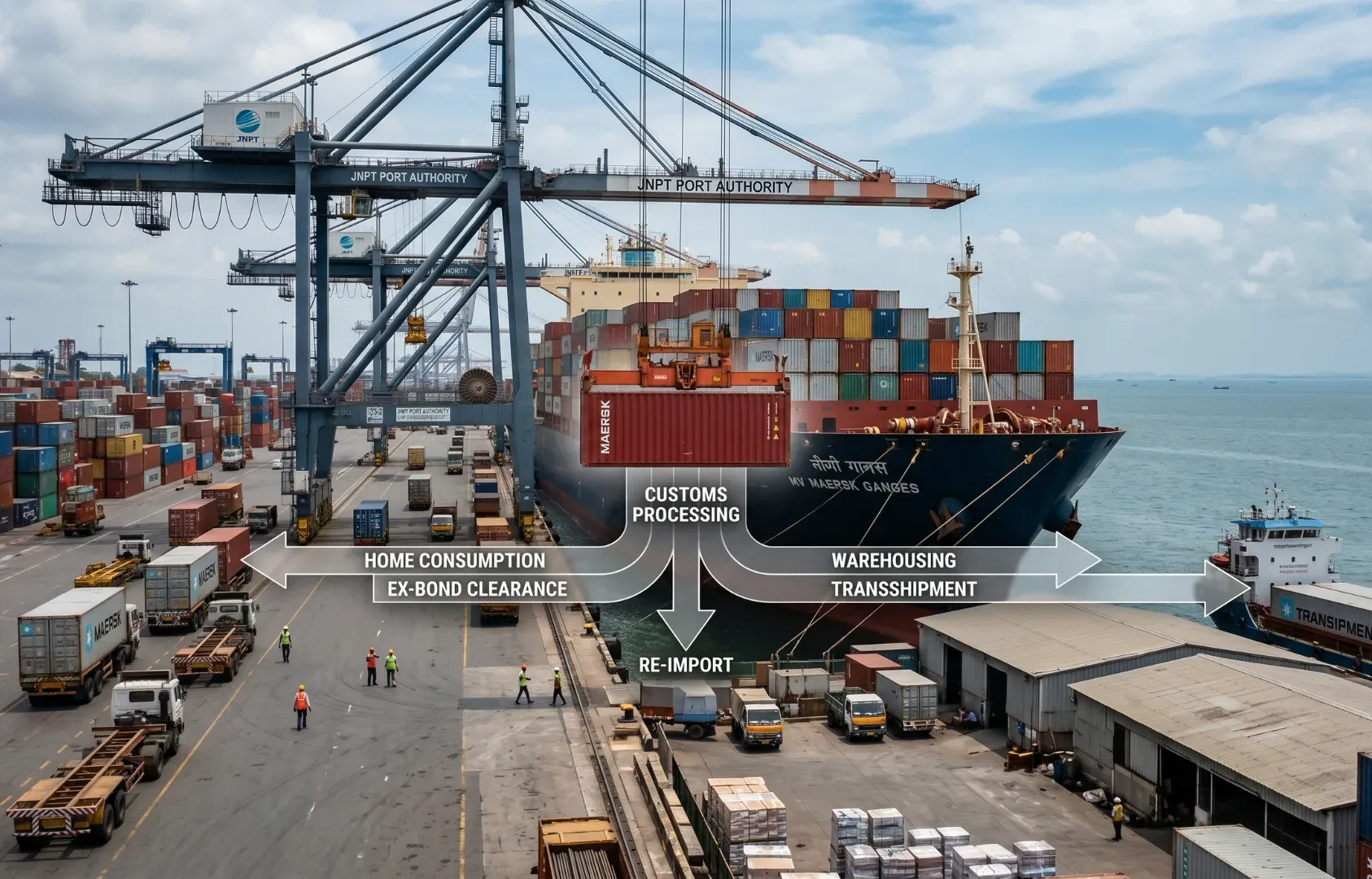
There are multiple types of Bill of Entry in India, and choosing the right type is crucial. The type determines whether goods move straight for home consumption, go into a bonded warehouse, are treated as re‑imports, or simply transshipped to another vessel or location.
Filing the wrong type can delay import clearance, change when you have to pay customs duty and IGST, and even affect eligibility for exemptions or GST credit. In 2026, most commercial imports fall into one of these core types of Bill of Entry:
Bill of Entry for Home Consumption (Section 46)
A Bill of Entry for Home Consumption is the most common type used in India. It’s filed when the importer wants immediate clearance of imported goods from the port into the Domestic Tariff Area (DTA) for sale, manufacturing, or their own use.
Here, duty is assessed on the assessable value and the correct customs tariff heading, and the importer must pay customs duty, IGST and other charges before customs issues Out of Charge. Once OOC is given, the goods are treated as cleared for home consumption and can move to the importer’s premises.
Bill of Entry for Warehousing (Bonded Warehouse)
A Warehousing or Into‑Bond Bill of Entry is filed when the importer wants to move goods from the port into a customs bonded warehouse without paying customs duty upfront.
This option allows the importer to defer customs duty and IGST until the goods are actually required and cleared from the warehouse, which can be very helpful for cash‑flow and inventory planning.
Ex-Bond Bill of Entry (Section 68)
An Ex‑Bond Bill of Entry is filed when goods that were previously warehoused in a bonded warehouse are finally cleared for home consumption.
Here, a key point is timing: duties and taxes are calculated based on the date of ex‑bond clearance, not on the original date of import. So if the customs duty rate or exchange rate has changed, the duty impact can either be favourable or unfavourable for the importer.
Once the ex‑bond BOE is assessed and the importer pays duty, customs issues Out of Charge, and the goods can move from the bonded warehouse to the importer’s factory or warehouse.
Re-import Bill of Entry
A Re‑import Bill of Entry is used when goods that were earlier exported from India are brought back into the country. This often happens when:
- Goods are returned by the foreign buyer as defective or rejected.
- Goods are sent abroad for repairs or testing and then sent back.
- Consignments are cancelled due to commercial disputes.
This is different from a regular home consumption BOE because the goods have a prior export history from India, and the re‑import is being regularised under special provisions rather than treated as a fresh import.
Transshipment Bill of Entry
A Transshipment Bill of Entry is filed when imported goods are not meant for clearance at the first Indian port but are to be moved further, typically transferred from one vessel to another at the same port or from one aircraft to another.
In this case:
- Goods are not cleared for home consumption or warehousing at that port.
- They remain under customs control while being moved to another vessel, aircraft, ICD or port for onward journey to another Indian or foreign destination.
Common use cases include hub ports that feed smaller coastal ports, or major airports from which cargo is flown to tier‑2 airports via domestic flights.
Other Common Types of Bill of Entry
Beyond the main categories, a few other types of Bill of Entry are frequently seen in practice.
Courier Bill of Entry
Used for low‑value consignments coming via authorised courier mode, often with simplified declaration and duty structures. Typical for e‑commerce orders, product samples or small spare parts.
High Sea Sales Bill of Entry
Used when the ownership of the goods changes hands while they are still on the high seas, before reaching the Indian port. The buyer files the BOE in their name and becomes responsible for duty and compliance.
Project Import Bill of Entry
Used for eligible projects such as power plants, refineries or large infrastructure projects that are granted special project import tariff headings and concessional duty rates, subject to project approval and conditions.
Each of these is still a Bill of Entry but tagged and treated differently based on the underlying transaction.

Documents Required to File a Bill of Entry
To file a Bill of Entry smoothly, you need a consistent set of shipping documents and commercial records. While exact requirements may vary by product or regulation, most importers will need:
- Commercial invoice and packing list
- Bill of Lading / Air Waybill
- Insurance policy or certificate (if applicable)
- Purchase order / sales contract
- Import licences or registrations (FSSAI, BIS, DGFT, Plant Quarantine, Drug Licence, etc.) where applicable
- Country of Origin certificate
- Test reports, product catalogues or technical write‑ups for classification, if required
- Any other supporting documents requested by customs (for example, royalty agreements or transfer pricing documentation for valuation)
These documents together form your customs documentation for the consignment. Ensuring accurate documentation, where the BOE, invoice and transport documents all match is one of the simplest ways to avoid queries, re‑assessment, and delays from customs officers.
Step-by-Step Bill of Entry Filing Process on ICEGATE
In India today, the Bill of Entry is usually filed electronically through the ICEGATE portal as part of the e‑governance push by CBIC. A practical view of the entry filing process looks like this:
1. Before filing: Prepare documents and choose the type
- Importer or CHA gathers the commercial invoice, packing list, Bill of Lading/AWB, insurance, licences and all other documents required.
- Decide the correct type of Bill of Entry (home consumption, warehousing, ex‑bond, re‑import, transshipment, courier, etc.), based on the business purpose and movement of goods.
2. Electronic filing on ICEGATE
- Log in with an active ICEGATE account as an importer or customs broker.
- Select the Bill of Entry module and enter key details: importer IEC and GSTIN, port code, CHA code, invoice details, HS codes, values and exemption notification numbers (if any).
- Upload scanned shipping documents and supporting papers as part of the entry filing procedure.
3. Assessment and duty calculation
- The system and customs officers jointly verify classification, assessable value and exemptions, and calculate customs duty, IGST, surcharges and any anti‑dumping duties.
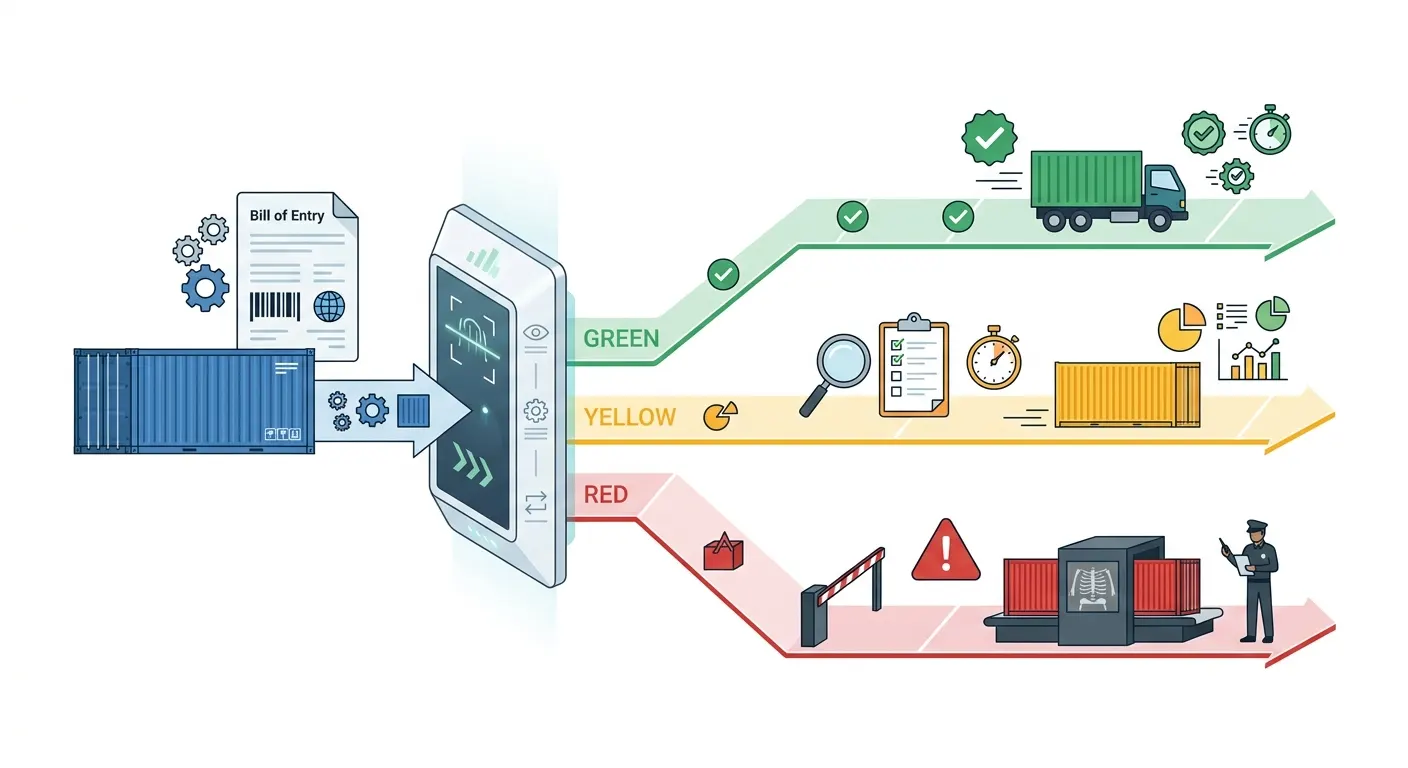
- Under the Risk Management System (RMS), some BOEs may be cleared with minimal checks (Green Channel), while others may be sent to Yellow/Red channels for detailed scrutiny or examination.
4. Duty payment and Out of Charge (OOC)
- After final assessment, the importer pays duty online via authorised banks linked to ICEGATE.
- Once payment is confirmed, customs issues Out of Charge, meaning the goods are officially cleared for home consumption or for movement to a bonded warehouse.
5. Tracking BOE status
- Importers can track the status of their Bill of Entry on ICEGATE using the BOE number, date and port code.
- Separately, IGST paid on imports also flows into the GST system and can be seen in GSTR‑2A/2B tabs like “Import of goods from overseas on Bill of Entry”.
A clean, well‑prepared BOE filing process reduces queries, speeds up customs clearance, and lowers port charges and detention.
Bill of Entry and GST (IGST and Input Tax Credit)
Under India’s Goods and Services Tax (GST) regime, imports are treated as inter‑State supplies and attract IGST on imports in addition to customs duties. The Bill of Entry is the key document that captures this IGST component.
For GST purposes:
- The BOE must mention the importer’s correct GSTIN, without which IGST cannot flow properly into the GST returns and electronic credit ledger.
- IGST paid on imports appears in GSTR‑2A and GSTR‑2B under specific tabs for imports from overseas or SEZ, based on BOE data pulled from ICEGATE.
Input Tax Credit (ITC) on IGST using BOE
Importers can claim input tax credit of IGST paid on imports, subject to conditions similar to other GST ITC:
- The importer is registered under GST and holds a valid GSTIN.
- IGST has actually been paid at the time of import and is reflected in GSTR‑2B.
- The importer holds a valid Bill of Entry and supporting documents (like the commercial invoice and payment proofs).
- ITC is claimed within the time limits specified under GST law (for example, by 30 November following the end of the financial year, based on recent rulings).
Historically, under the earlier services tax and central excise regimes, similar import documents were used to support CENVAT credit; under GST, the Bill of Entry continues to play that pivotal tax‑credit role.

Role of Customs Broker / Customs House Agent in Import Clearance
Majority importers, especially SMEs, rely on a customs broker / Customs House Agent (CHA) to handle BOE filing and overall entry filing process.
Key ways a CHA adds value:
- Selecting the correct customs tariff heading for each product, based on technical literature and HSN rules.
- Determining assessable value, including freight, insurance and other additions, and checking the impact of any royalties or after‑sale payments.
- Preparing and uploading customs documentation, BOE, invoices, packing lists and licences on the ICEGATE portal.
- Liaising with the customs officer for assessment, examination and responding to queries.
- Coordinating with terminals, CFSs, shipping lines or airlines to ensure cargo is moved out quickly post OOC.
Because they operate under a unique customs house agent code and are familiar with local procedures, a good CHA can help you avoid common mistakes, reduce clearance time and minimise disputes with customs authorities.
Common Mistakes in Bill of Entry Filing (and How to Avoid Them)
Even experienced teams make avoidable mistakes with BOE filing. Some of the most common ones are:
- Wrong type of Bill of Entry selected
For example, choosing home consumption when a warehousing model was planned, or ignoring re‑import conditions. This can mess up duty timing and benefit eligibility.
- Incorrect HS code / customs tariff heading
Misclassification can mean under‑ or over‑payment of duty and IGST, and can invite audits and penalties.
- Mismatch between BOE and commercial invoice / packing list
Differences in quantities, descriptions or currency lead to system mismatches and queries.
- Wrong or missing GSTIN
Missing or incorrect GSTIN on the BOE can stop IGST from flowing correctly into GSTR‑2B, blocking input tax credit.
- Claiming ineligible exemptions or missing eligible ones
Incorrect use of notification numbers leads to future disputes or loss of benefits.
- Incomplete supporting documents or poor‑quality scans
This triggers repeated document calls and slows assessment.
- Ignoring BOE amendments or re‑assessment
Not correcting errors quickly can escalate into bigger compliance issues later.
FAQ
What are the main types of Bill of Entry in India and when should each be used?
The main types are Bill of Entry for Home Consumption, Warehousing / Into‑Bond BOE, and Ex‑Bond BOE, plus special forms like Re‑import, Transshipment, Courier, High Sea Sales and Project Import BOEs. Each is used based on whether goods are for immediate use, warehousing, re‑import or onward movement.
What documents are required to file a Bill of Entry?
Typically you need a commercial invoice, packing list, Bill of Lading/AWB, insurance policy (if any), purchase order, licences/registrations (FSSAI, BIS, DGFT etc.), origin certificate and other supporting documents demanded by customs.
Can I claim GST input tax credit without a valid Bill of Entry?
No. To claim input tax credit of IGST on imports, you must have a valid Bill of Entry, correct GSTIN on the BOE, and IGST should appear in GSTR‑2B within the allowed time limit.
How can I check or track my Bill of Entry status online?
You can track BOE status on ICEGATE using the BOE number, date and port code, and view key events like assessment, duty payment and OOC. On the GST portal, you can also see import‑related IGST entries under Search BoE and in GSTR‑2A/2B.
How long is a Bill of Entry valid, and how long should I keep it?
Practically, a BOE is valid around the arrival and clearance period of the consignment, but from a records perspective you should preserve it for the statutory retention period for customs, GST and income‑tax audits (often several years).
What is the difference between a Bill of Entry for home consumption and for warehousing?
A home consumption BOE clears goods directly into the Domestic Tariff Area with duty payable immediately, while a warehousing bill of entry moves goods into a bonded warehouse with duty payment deferred until ex‑bond clearance.
When is a Re-import Bill of Entry used, and what benefits are available?
It is used when goods previously exported from India are brought back, for example due to rejection or repair. Subject to conditions and documentation, duty exemptions or refunds may be available.
Do I need a customs broker / CHA or can I file a Bill of Entry myself?
Legally, an importer can file BOEs directly, but many businesses prefer a customs broker / CHA because they understand classification, valuation, ICEGATE filing and local port procedures, reducing errors and delays.