Form 27Q, Now Form 144: The TDS Return for Payments to Non-Residents


If your business pays a foreign company for software, consultancy, royalties or technical services, you deduct tax before you remit. Form 27Q is the quarterly return where you report that deduction. From the 2026 tax year it is called Form 144.
The form is the same job under a new number, but the number is not the only thing that moved. The section it is filed under, the rule that governs it, the certificate you owe your vendor afterwards and the statement where your vendor sees the credit have all been renumbered too. Working off the old references will not stop you filing, but it will make every conversation with your CA and your bank slower than it needs to be.
The short answer
What it is. A quarterly statement reporting tax deducted at source on payments other than salary made to non-residents, including foreign companies. Filed under section 397(3)(b) of the Income-tax Act, 2025, and prescribed by rule 219 of the Income-tax Rules, 2026.
Who files it. The deductor, meaning you, the Indian business making the payment. Not the vendor. You need a TAN, which is separate from your PAN.
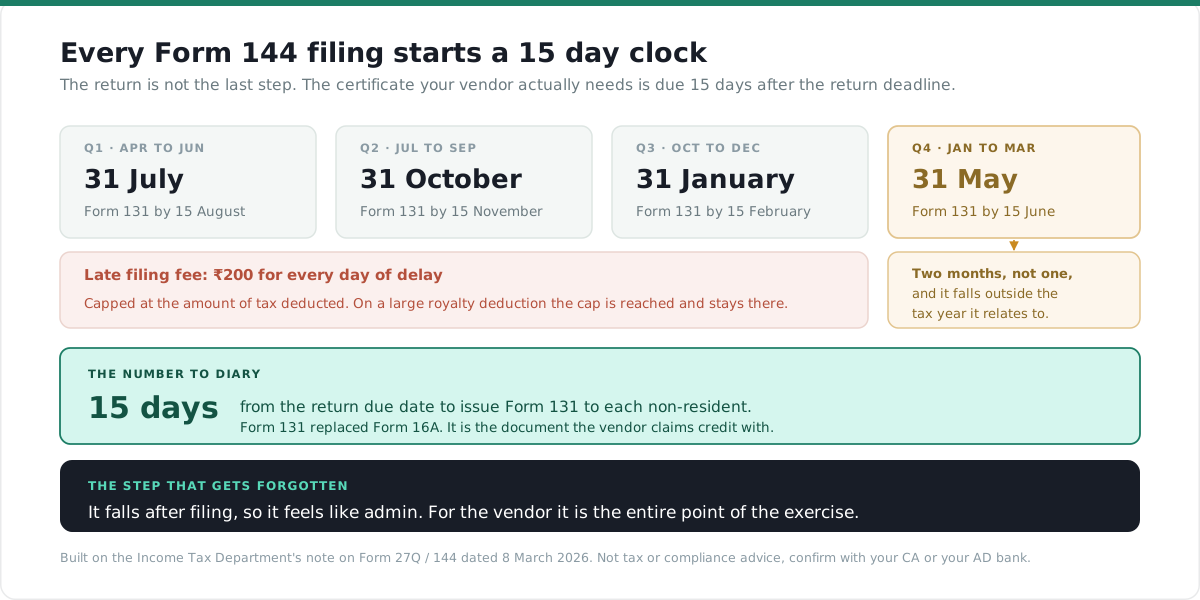
When. 31 July, 31 October and 31 January for the first three quarters, and 31 May of the following year for the January to March quarter.
What you owe afterwards. Form 131, the TDS certificate, issued to each non-resident within 15 days of the return due date. This was Form 16A.
Roughly 1.5 lakh of these are filed each year. It is a small population, which is part of why the guidance around it is thinner than for the domestic TDS returns.
What changed, and what did not
The Income-tax Act, 2025 and the Income-tax Rules, 2026 renumbered the whole chain. Nothing about the substance of the obligation changed. Every reference did.
| Item | Old reference | Current reference |
|---|---|---|
| The quarterly return | Form 27Q | Form 144 |
| Section it is filed under | Section 200(3) | Section 397(3)(b) |
| Rule prescribing it | Rule 31A | Rule 219 |
| Time limit for depositing the tax | Rule 30 | Rule 218 |
| TDS certificate to the vendor | Form 16A | Form 131 |
| Where the vendor sees the credit | Form 26AS | Form 168 |
| Lower or nil deduction certificate | Section 197 | Section 395 |
| Accountant certificate, deductor not in default | Form 26A | Form 149, under section 398(2) |
The deduction itself sits in Chapter XIX-B of the 2025 Act. For payments to non-residents the charging provision is section 393(2), which is the successor to section 195.
Two practical consequences. Your TDS software and your CA's working papers may still print the old numbers for a while, and that is not an error as long as the underlying treatment is right. But a certificate you send a foreign vendor saying "Form 16A" when the portal generated a Form 131 invites a question you will have to answer by email at 2am in their
Form 144 or Form 26Q: which one you file
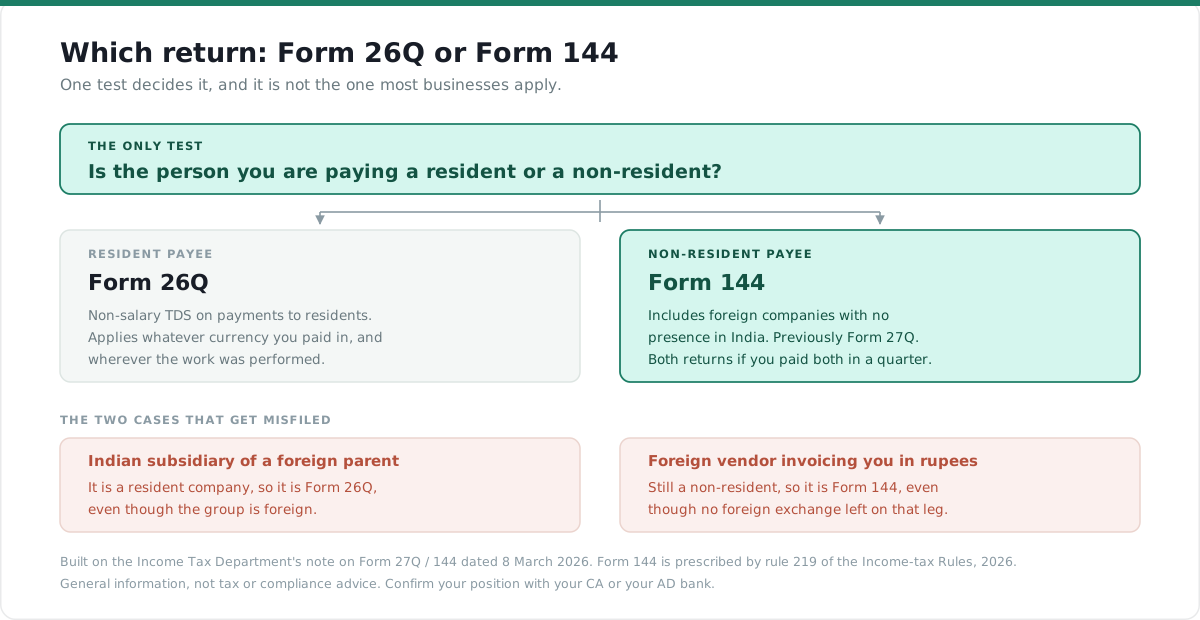
This is the decision people get wrong most often, and it is worth being precise about, because the test is not what most people assume.
The test is the residency of the person you are paying. Not the currency. Not where the work was performed. Not whether the invoice came from abroad.
Pay a resident vendor, and non-salary TDS goes on Form 26Q, whatever currency you paid in. Pay a non-resident, including a foreign company with no presence in India, and it goes on Form 144. If you pay both in the same quarter, you file both returns. They are separate statements with separate acknowledgements.
Two cases that trip businesses up. An Indian subsidiary of a foreign parent is a resident company, so payments to it are Form 26Q even though the group is foreign. And a foreign vendor who invoices you in rupees is still a non-resident, so that payment is Form 144 even though no foreign exchange left the country on that leg.
If your payment is to a resident and you landed here looking for the general process, our guide to filing a TDS return online covers the Form 26Q route.
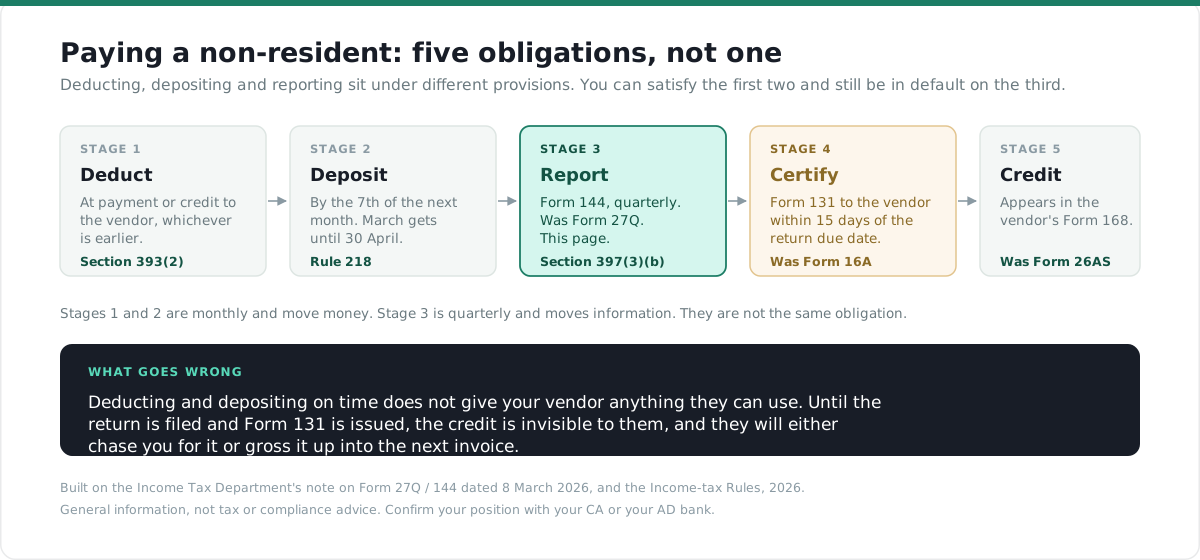
Deducting and reporting are two different obligations
Worth separating, because they live under different sections and fail in different ways.
Deducting is section 393(2). It bites at the point of payment or credit to the vendor's account, whichever is earlier. Crediting a provision at year end counts, even though no money has moved.
Depositing is governed by rule 218. The tax reaches the government by the 7th of the month after deduction, except for March deductions, which get until 30 April.
Reporting is section 397(3)(b), and that is what Form 144 does. It comes quarterly, after the fact, and it is the step that turns your deposit into credit the vendor can actually use.
You can deduct correctly, deposit on time and still be in default on the third one. Late filing does not undo the deposit, but it does hold up the vendor's credit, and a vendor who cannot see the credit will chase you for it or, worse, gross up their next invoice.
If you are working out whether tax is deductible at all, and at what rate, that belongs upstream in Section 195, now section 393(2). This page assumes the deduction has already happened.
When it is due
| Quarter | Period covered | Due date |
|---|---|---|
| Q1 | April to June | 31 July |
| Q2 | July to September | 31 October |
| Q3 | October to December | 31 January |
| Q4 | January to March | 31 May of the following year |
The Q4 date is the one to diary. It sits two months after the quarter ends rather than one, and it falls outside the tax year it relates to, so it is easy to miss in a year-end close that has already been signed off.
Late filing carries a fee of ₹200 for each day of delay, capped at the amount of tax deducted. The cap matters: on a small deduction the fee stops growing quickly, but on a large one it does not, and a quarter filed six months late on a substantial royalty payment reaches the cap and stays there.
What the return actually asks for
Form 144 has a single annexure, filed for all four quarters, and it goes deeper on each payee than the domestic returns do.
The three highlighted fields are what separate this return from Form 26Q. A domestic return does not ask which country the money went to, or whether you applied a treaty rate. This one does, and those fields are where a mismatch with your Form 145 declaration and your bank's purpose code becomes visible to the department.
Practically, that means the treaty position you take at remittance time is the one you have to restate here, three months later, from records. Decide it once, write it down, and keep the supporting documents with the payment file rather than reconstructing it at filing time.
Paying an overseas vendor?
EximPe is an RBI-authorised Payment Aggregator, Cross Border. Certificate No. 291/2026.
The purpose code and FEMA documentation are handled inside the transaction rather than chased afterwards, you get a live FX rate, and the paperwork is closed out with the payment. Built for Indian businesses paying across borders.
AD1 accounts are for Indian entities. Tax deduction and the quarterly return remain your obligation and your CA's, not your payment provider's.
When your vendor has no PAN
This is the single most common reason a non-resident TDS position falls apart, and it is worth understanding before you negotiate the contract rather than after.
The default rule is unforgiving. Where the payee does not furnish a PAN, tax is deducted at a higher rate, and 20% is the figure most businesses end up quoting. Most foreign vendors have no Indian PAN and no intention of getting one for a single invoice.
There is relief. Rule 37BC removes the higher-rate requirement for a non-resident, including a foreign company, where the payment is interest, royalty, fees for technical services, dividend, or consideration for the transfer of a capital asset, provided the payee furnishes prescribed details and documents to you instead of a PAN. In practice that package is the vendor's name, address and country of residence, their tax identification number in that country, and a Tax Residency Certificate.
Three things follow from that.
The relief is by category, not by vendor. If your payment does not fall in one of the listed categories, the relief does not reach it, however cooperative your vendor is.
The documents have to exist before you deduct. A TRC obtained in September does not fix a payment made in June. Build the request into onboarding, not into the quarter-end scramble.
A treaty rate needs the same paperwork. If you are deducting at a DTAA rate rather than the Act rate, you are declaring that in the Form 144 annexure, and the TRC plus Form 10F is what supports it. The relief from the higher rate and the entitlement to the treaty rate are two separate questions that happen to need overlapping documents.
How to file it
The mechanics have not changed with the renumbering.
Prepare the statement using the Return Preparation Utility from TIN-NSDL. Validate it with the File Validation Utility, which produces a .fvu file if there are no errors. Upload that file on the e-filing portal, or submit it physically at a TIN Facilitation Centre. The data is then processed at CPC-TDS.
Before you start, have four things: the challans for tax already deposited to the government, PAN details for every deductee that has one, the TRC and Form 10F where you are claiming treaty benefit, and any certificate issued under section 395 for lower or nil deduction.
Processing returns either a clean result or a statement with defaults. If it comes back with defaults, you pay what is due and then file a correction statement. A correction is a normal part of this process rather than a black mark, and it is a great deal cheaper than leaving a default open.
What you owe the vendor afterwards
Once the return is processed, TRACES generates Form 131, the TDS certificate for non-salary income that used to be Form 16A. You must issue it to each non-resident deductee within 15 days of the due date for filing Form 144.
That deadline is not optional and it is the part most likely to be forgotten, because it falls after the return is filed and feels like admin. For the vendor it is the whole point. It is the document they use to claim credit, either in an Indian return or against their own tax at home under the treaty. A foreign vendor chasing a missing certificate is the most common reason a finance team ends up reopening a quarter they thought was closed.
Once processed, the amount also appears in the deductee's Form 168, the Annual Information Statement that replaced Form 26AS.
Where this sits against Form 145 and the purpose code
Three separate obligations attach to one outward payment, and they are often confused because they overlap in time.
Form 145 and Form 146, previously 15CA and 15CB, are filed before the money leaves. They are the declaration to the bank that tax has been dealt with. Our guide to Form 15CA and 15CB, now Forms 145 and 146 covers when a CA certificate is actually required.
The purpose code is applied at the moment of remittance by your bank, and it classifies the payment for RBI's balance of payments reporting rather than for tax. Getting it wrong does not change your tax position, but it does make your paperwork inconsistent. The complete RBI purpose code list sets out which code fits which payment.
Form 144 comes after the quarter ends, and it reports to the income tax department what you already told the bank.
The same transaction therefore gets described three times, to two different regulators, on three different timelines. They need to agree. A payment declared as fees for technical services on Form 145, sent under a software consultancy purpose code, and reported at a treaty rate on Form 144 without a TRC on file is three inconsistent statements about one invoice, and each one is individually defensible until somebody lines them up.
Frequently Asked Questions
Is Form 27Q still valid, or do I have to use Form 144?
They are the same return. Form 27Q was the number under the Income-tax Rules, 1962. Form 144 is the number under the Income-tax Rules, 2026. Utilities and advisers may use either name for a while.
Do I need a TAN to file Form 144?
Yes. TAN is separate from PAN and is the number under which you deduct and deposit. You cannot file the return without one.
My foreign vendor refuses to get an Indian PAN. What are my options?
Check whether the payment falls within the categories covered by the rule 37BC relief, which include interest, royalty, fees for technical services, dividend and consideration for transfer of a capital asset. If it does, the vendor provides name, address, country of residence, their foreign tax identification number and a Tax Residency Certificate in place of a PAN. If it does not, the higher rate applies.
What is the difference between Form 26Q and Form 144?
Form 26Q reports non-salary TDS on payments to residents. Form 144 reports non-salary TDS on payments to non-residents, including foreign companies. The test is the payee's residency, not the currency of payment.
When do I have to give my vendor the TDS certificate?
Form 131, previously Form 16A, must be issued within 15 days of the due date for filing Form 144.
What happens if I file late?
A fee of ₹200 for every day of delay, capped at the amount of tax deducted. Separately, the vendor's credit is delayed until the return is processed.
Does my payment provider file this for me?
No. A payment provider handles the remittance, the FEMA documentation and the purpose code. Tax deduction, deposit and the quarterly return stay with you and your CA.