Budget 2026's Hidden Opportunity: Reviving 200 Legacy Industrial Clusters
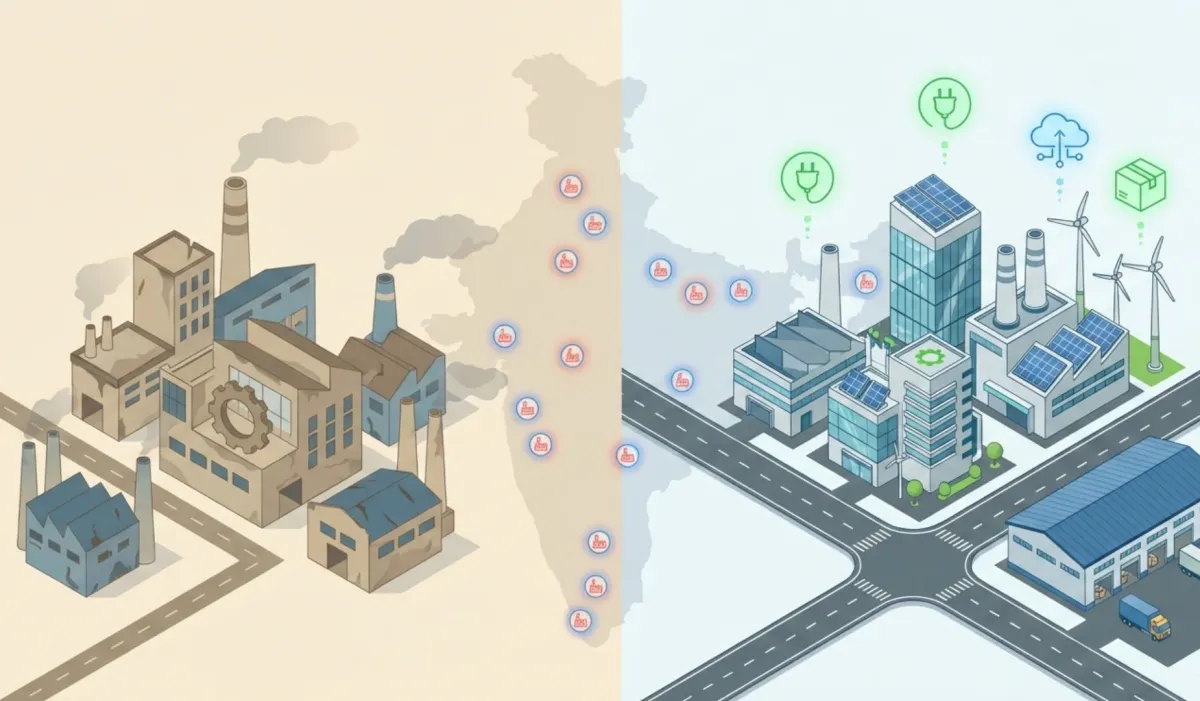
Budget 2026 announced a scheme to revive 200 legacy industrial clusters, which currently employ 114+ million workers and generate 35% of India's exports. Unlike new greenfield cities that cost ₹50+ lakh per job, upgrading existing clusters costs only ₹15-20 lakh per job. This quiet opportunity could reshape manufacturing by modernizing infrastructure in towns like Malegaon, Kanpur, and Kolhapur that have made things for decades but haven't upgraded in 15-20 years.
What This Actually Means
Budget 2026 buried one announcement, while everyone debated income tax slabs and market crashes, a scheme to revive 200 legacy industrial clusters has gone completely unnoticed. No implementation roadmap. No official list. No timeline. Yet this could be more consequential than all the splashy announcements combined.
The government's logic is simple, Instead of building new greenfield cities, upgrade what already works.
The Math That Changes Everything
What These 200 Clusters Currently Provide
- 40% of India's industrial manufacturing output
- 35% of India's total exports
- 114+ million direct and indirect jobs
- Bhiwandi textile cluster: 0.5 million employment alone
- Kolhapur engineering cluster: 4,000+ manufacturers, 50,000+ jobs
These aren't failing towns—they're survivors that need upgrades, not replacement.
A Complete Strategic Breakdown of The 200 Clusters
Cluster Category #1: Textiles & Apparel (~40 clusters)
Geographic Spread:Weaving/Processing: Malegaon, Bhiwandi, Solapur, Ichalkaranji, Akola, Amravati, Burhanpur, Khargone, Ujjain, Bhilwara, Beawar, Sircilla, Gadwal, Kurnool | Garments: Bellary, Raichur, Gaya, Bhagalpur, Dindigul, Perundurai, Karimnagar | Handloom: Chanderi, Maheshwar, Sambalpur, Bargarh, Nuapatna, Venkatagiri, Pochampally.
Current Challenge: Outdated powerlooms (40% energy inefficient), export competition pressure, compliance cost squeeze.
What Changes:
- High-speed looms reduce energy consumption by 40%
- Productivity increases by 30%
Shared dyeing facilities reduce water usage by 60%
Cluster Category #2: Leather & Tanning (~15 clusters)
Geographic Spread: Kanpur, Unnao, Agra, Dewas, Indore, Jalandhar, Kolkata–Bantala, Ranipet, Dindigul.
The Biggest Barrier: Environmental compliance costs = 10-12% of total project expenses. Only 82% of units currently comply with CEMS.
Compliance Cost Reduction Strategy:
Post-Upgrade Economics:
- Margin improvement: 15-20%
- Export premium: 20-30%
Timeline to payback: 3-5 years
Cluster Category #3: Engineering & Metalworking (~30 clusters)
Geographic Spread: Kolhapur, Sangli, Satara, Batala, Mandi Gobindgarh, Yamunanagar, Howrah, Durgapur, Bokaro, Raipur, Bhilai, Belagavi, Hubballi, Dharwad, Tiruchirappalli.
Budget 2026 Tools Available:
Step 1: Access Hi-Tech Tool Rooms by CPSEs for precision manufacturing capabilityStep 2: Apply for Container Manufacturing Scheme (₹10,000 crore, 5-year support)Step 3: Use TReDS platform for working capital financingStep 4: Apply for SME Growth Fund for machinery modernization
What CNC Machine Adoption Delivers:
- Productivity increase: 40%
- Defect reduction: 60%
- Payback period: 2-3 years via TReDS + SME Fund
Export price premium: 10-15%
Cluster Category #4: Chemicals, Dyes & Plastics (~20 clusters)
Geographic Spread: Dombivli, Ambernath, Tarapur, Panipat, Meerut, Hapur, Cuddalore, Karaikal, Puducherry, Haldia, Durgapur, Kanpur Dehat.
Budget 2026 Intervention:
Post-Migration Impact:
- Environmental compliance cost reduction: 60%
- Export competitiveness improvement: 30%+
Timeline to full operations: 3-5 years
Cluster Category #5: Handicrafts & Artisanal (~25 clusters)
Geographic Spread: Moradabad (10,000+ units, 100,000+ workers), Sambhal, Saharanpur, Firozabad, Khurja, Barmer, Jodhpur, Bastar, Bankura, Bishnupur, Channapatna, Kondapalli, Etikoppaka, Pipli, Puri.
How E-Shipping Bill Integration Helps:
- Export documentation complexity: Reduced from 5-7 steps to 2-3 steps
- Customs clearance time: Cut by 50%
Export premium via collective branding: 20% increase possible
Cluster Category #6: Food Processing & Agro-Based (~20 clusters)
Geographic Spread: Muzaffarnagar, Lakhimpur Kheri, Nizamabad, Erode, Sangli, Kolhapur, Malda, Murshidabad, Guntur, Warangal, Karimnagar, Hoshangabad, Sehore
Cold Chain Impact:
Cluster Category #7: Coastal & Export-Linked Legacy Hubs (~10 clusters)
Geographic Spread: Kandla–Gandhidham, Alappuzha, Kollam, Tuticorin, Nagapattinam, Cuddalore, Karaikal.
Budget 2026 Game-Changer: Dedicated Freight Corridors (Dankuni to Surat).
What Improves:
Benefit #1: Reduces logistics time by 40-50%Benefit #2: E-documentation cuts clearance from 24-48 hours to 4-8 hoursBenefit #3: Export competitiveness improves by 25-30%
Budget 2026 Allocation
Clusters will get "some" support, but won't be fully funded. MSMEs will need to co-invest or take loans.
Why This Matters More Than You Think
The budget headlines focus on "new"—semiconductors, electronics, startups. But the real story is upgrading "old." India's manufacturing transformation won't be built only in superstar cities. It will be built by upgrading the industrial middle.
The Strategic Insight:
- Growth happens in champions
- Transformation happens in the middle
35% of India's exports come from these clusters. Infrastructure modernization directly translates to export competitiveness. Better logistics, faster customs clearance, compliance infrastructure—all reduce friction costs and enable premium positioning.
FAQ: Questions Importers & Trade Professionals Actually Ask
Which Cluster Should My Company Focus On?
Identify your cluster category first, then assess local readiness and competition within that cluster. Textiles get priority focus first, food processing gets it later.
Do I Need to Co-Invest, or Is This Fully Funded?
Environmental infrastructure requires co-investment. Machinery modernization is equity-funded (SME Growth Fund) but needs your contribution. Working capital can come from TReDS platform.
How Does TReDS Help With Cluster Upgradation?
You can finance machinery purchases by discounting receivables at 10-12% rates vs. traditional 14-16% rates. Clusters using collective TReDS get better rates and faster approvals.
What's the Realistic Timeline for Productivity Gains?
Phase 1 cluster identification: FY27. Infrastructure development: FY28-29. Operational readiness: FY30-31. Individual MSMEs can move faster if they co-invest early, but cluster-wide transformation takes time.